

Originally published on Pharmaceutical Commerce as a guest blog authored by Chris Dowd, SVP, Market Development at ConnectiveRx.
Pharma companies allocate enormous amounts of money to copay programs, one of their largest controllable marketing expenses. These programs began as a way to make drugs more affordable for patients but have evolved into a major factor in gross-to-net economics. There are millions of dollars at stake in any specialty medication brand every year.
![[Guide] Pricing & Reimbursement in Hubs](https://no-cache.hubspot.com/cta/default/8150749/ad657047-a01a-406d-8e45-7d27fc43ef04.png)
As we enter 2026, copay programs face new pressures. Payers are intervening more aggressively, accumulator and maximizer tactics continue to evolve, and misuse at pharmacies stubbornly persists. Many brands now spend as much on copay as they do on other commercial strategies but manage it with surprisingly little scrutiny. Copay programs are necessary for script lift and adherence, but there’s a real question looming: is your copay program structured to protect revenue while offering patient benefits that will move the needle?
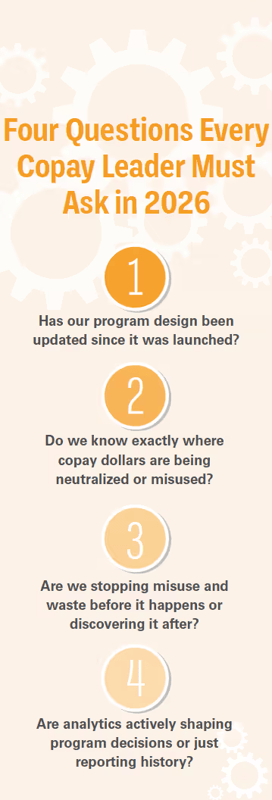
Here's a four-pillar framework proven to protect funds earmarked for copay and help brands control costs, all while maintaining patient access and driving utilization.
Pillar 1: Program Design Protects Gross-to-Net
In reality, program design covers everything from offer amount and caps to eligibility rules and channel mix, yet many programs are set at launch and rarely revisited. Copay programs work best when offers and caps are set with a clear purpose and revisited as usage patterns take shape.
For example, when program data is examined closely, it’s possible that a small number of high-cost claims could account for a disproportionate share of copay spend. Looking more closely, if a small number of patients drive an extraordinary volume of copay expenditure, without staying on therapy any longer than everyone else, your gross-to-net takes a hit – a silent drain on brand resources that can undermine the entire copay strategy if not addressed.
Steps to take in 2026
Look closely at your copay data. These patterns persist when design decisions are rarely revisited once a program is live. Revisit your program design. In many cases, small changes to caps or offers are enough to rein in spending without hurting volume. A strong program is dynamic and responsive to new information in real time.
Pillar 2: Prevent Misuse of Copay Programs at the Pharmacy
Current estimates of pharmacy-originated copay misuse prove it’s causing a significant, and ever-increasing, amount of gross-to-net leakage.
Stopping copay misuse is cleanest when incidents are caught before money goes out the door. But industry standard solutions for pharmacy-level misuse are handled after the fact by reviewing claims, identifying patterns, and employing lengthy manual audit processes to recoup funds. This type of solution has value and should not be dismissed but pharma companies must be aware of the challenges in recouping funds after the fact. Pattern analysis can surface some copay misuse tactics that are difficult to detect in real time. The challenge in relying only on this retrospective approach is obvious: once misuse is identified, the money has already been spent, and recovery is lengthy and never guaranteed.
New, advanced approaches focus on mitigating misuse by embedding a proactive layer of protection directly into the pharmacy workflow. Claims are evaluated in seconds using patient, prescriber, pharmacy, and claim-level signals and attempts at misuse can be denied, thus stopping bad claims before payment matters affect your bottom line.
Steps to take in 2026:
Use both methods. Relying on only one approach will leave you more open to economic impact. Retrospective methods help explain where issues have shown up, but real-time checks are what stop problems as they happen.
 Pillar 3: Accumulator & Maximizer Strategies – Know the Risk Landscape
Revenue protection depends on having a clear view of how payer behavior continues and changes.
According to 2025 data from MMIT, surveyed payers anticipate that nearly half (46%) of their plan sponsors would opt to utilize a copay accumulator program and more than half (53%) would opt into a copay maximizer program by Q3 2025 – which marks a 10% increase in overall member enrollment in plans that use one of those two copay capture methods.
Most payers use these programs in some form because the results are financially proven. Relying on manufacturer copay dollars as revenue is now part of the fabric of utilization management.
For pharma companies, static approaches to mitigation struggle to keep pace with rapidly evolving payer tactics. In some cases, payers now mask accumulator or maximizer use to avoid traditional detection methods. Approaches that once worked may no longer be sufficient. Between the pervasiveness of use and evolving strategies we see from payers, this remains a central issue for gross-to-net performance.
Steps to take in 2026:
Revisit your capabilities to identify patients being targeted by these programs. Pre-claim identification remains best-in-class, but it must continue to evolve. 2025 saw a sharp rise in alternative funding programs, which route patients away from their commercial pharmacy benefit into alternative channels – sometimes manufacturer-sponsored charitable foundations. Make sure your solution is able to identify those as well.
Pillar 4: Advanced Analytics – Turning Copay Data Into Gross-To-Net Strategy
Think about copay solutions data this way: ‘Reporting’ illustrates what happened while ‘analytics’ deliver insight as to what to do next.
Most manufacturers receive copay data reporting, but the most economically sound medication brands use it to guide strategy. Sophisticated analytics tackle real business questions: Does the program perform as designed? Where does spending miss the mark? What happens to volume and cost if we change the offer?
Pre-launch, analytics can prevent problems through forecasting and benchmark comparisons. After launch, analysis shows where access and spend are lining up – and where they aren’t – so teams can make changes without losing volume.
Steps to take in 2026:
Executive leadership is looking for growth that doesn’t come at the expense of gross-to-net. Dig into your copay data to drive action, not just track results. Work with your copay provider to establish a cadence of sessions designed to review and set actions based on analytics. Implement changes often and set a date to review the impact of any new variables at play in market.
Re-evaluate your program now: Protect Revenue While Preserving Access
None of the four tactics discussed will optimize a copay program when used in isolation. When program design, controls, and analytics aren’t connected, problems show up quickly. Strong design, without controlling for misuse, leaves huge financial exposure. And analytics don’t add much value if lessons around payer behavior aren’t part of the discussion.
From a gross-to-net standpoint, copay now needs to be managed the same way pricing, contracting, and access are managed. The strongest copay strategies don’t compromise access for financial discipline or vice versa; they treat them as the same problem to solve. Copay works because it supports access and drives utilization. But programs don't stay sustainable just because they're generous.
In a market where payers keep adapting their tactics, unmanaged copay spend becomes a liability. Managed well, it remains one of the most effective commercial tools manufacturers have.